Thursday, March 22, 2012

FOR THEY SHALL ALL KNOW ME


This is my last blog entry for the Journey class. I will facilitate a new class beginning next week on the first of April, April Fools day. There's bound to be some symbolism regarding such an auspicious date but I'm not touching it. 

We have been studying three of the major covenants from the Jewish scriptures in the last several weeks: Noah, Abraham and Moses. This week, there are two different sets of readings in the lectionary. Once I read the Jeremiah passage, I thought it appropriate to end on the promise of future covenant as it not only related to the time of Jeremiah but to our own Journey class.

When I was preparing to come to Richmond for seminary, a retired pastor who was a member of my ordination council, counseled me on remembering that "the best is yet to come." I must admit that after working in a number of intensive cares at two different hospitals the view of the future (growing older) was not what I what have initially referred to as the "best" to come. Being fairly older than the average seminary attendee, one can look back with some trepidation on what might have been done better in the past. But the past is just that: past. Time to move forward. For me, God is forgiving of the past and busy establishing the future by being involved today. 


How does the passage below speak to you where you are in your covenant with God and with others?

Jeremiah 31:31-34
31:31 The days are surely coming, says the LORD, when I will make a new covenant with the house of Israel and the house of Judah.

31:32 It will not be like the covenant that I made with their ancestors when I took them by the hand to bring them out of the land of Egypt--a covenant that they broke, though I was their husband, says the LORD.

31:33 But this is the covenant that I will make with the house of Israel after those days, says the LORD: I will put my law within them, and I will write it on their hearts; and I will be their God, and they shall be my people.

31:34 No longer shall they teach one another, or say to each other, "Know the LORD," for they shall all know me, from the least of them to the greatest, says the LORD; for I will forgive their iniquity, and remember their sin no more.

Thursday, March 15, 2012

IF IT'VE BEEN A SNAKE IT WOULD'VE BIT YA

Nehushtan at Mt .Nebo
Nehushtan - (Nehush - snake)  the name of the cult serpent of brass upon a pole which King Hezekiah destroyed because by the time of his reign the Jewish people were worshiping it as an idol. According to the Jewish Encyclopedia and Jewish Virtual Library (on-line versions), the cult serpent has some tradition with the story in Numbers 21:4-9 but does not seem to have taken on the Nehushtan name until the time of Hezekiah. Accordingly, the serpent on a post is supposed to be shedding its skin, a sign of rebirth or healing for those who "look" upon it. According to the above references, the word "look" in verse 21:9 was not merely a glance but a time of acknowledgment of one's own conduct which resulted in repentance. This repentance was what saved the person from death.


Two questions: Is there difference in the way God approaches people in the Numbers passage compared to the John passage?
How do we sometimes change in relation to the gifts God has given us as illustrated in the time of Moses compared to the time of Hezekiah?

Numbers 21:4-9
21:4 From Mount Hor they set out by the way to the Red Sea, to go around the land of Edom; but the people became impatient on the way.

21:5 The people spoke against God and against Moses, "Why have you brought us up out of Egypt to die in the wilderness? For there is no food and no water, and we detest this miserable food."

21:6 Then the LORD sent poisonous serpents among the people, and they bit the people, so that many Israelites died.

21:7 The people came to Moses and said, "We have sinned by speaking against the LORD and against you; pray to the LORD to take away the serpents from us." So Moses prayed for the people.

21:8 And the LORD said to Moses, "Make a poisonous serpent, and set it on a pole; and everyone who is bitten shall look at it and live."

21:9 So Moses made a serpent of bronze, and put it upon a pole; and whenever a serpent bit someone, that person would look at the serpent of bronze and live.


John 3:14-21
3:14 And just as Moses lifted up the serpent in the wilderness, so must the Son of Man be lifted up,

3:15 that whoever believes in him may have eternal life.

3:16 "For God so loved the world that he gave his only Son, so that everyone who believes in him may not perish but may have eternal life.

3:17 "Indeed, God did not send the Son into the world to condemn the world, but in order that the world might be saved through him.

3:18 Those who believe in him are not condemned; but those who do not believe are condemned already, because they have not believed in the name of the only Son of God.

3:19 And this is the judgment, that the light has come into the world, and people loved darkness rather than light because their deeds were evil.

3:20 For all who do evil hate the light and do not come to the light, so that their deeds may not be exposed.

3:21 But those who do what is true come to the light, so that it may be clearly seen that their deeds have been done in God."

Thursday, March 8, 2012

THE THIRD COVENANT. EXPRESSION OF LAW

A "run of DeMille" production
Maimonides, physician to Salidin and renowned Jewish scholar of the late middle ages, stated that for Judaism, Moses was the principal and greatest prophet of all for God's people. 
In today's lectionary choice we follow in the path of the covenants which God instituted with his people. Noah, Abraham and now Moses. For the Jewish people it is the covenant of the law with Moses that brings salvation to those who follow and obey it.
Jesus' distillation of the Ten into two sides of the same commandment regarding God and neighbor transformed the decalogue into a more efficient travelogue of religious ethics for our journey. Though by no means the first code of conduct from the mid-east, the "Top Ten" have remained influential in Western minds up to today. And its placement as public edifice has been the issue of more than several court decisions, even though most of those Ten Commandment displays were placed in parks and public places in the 1950s by Paramount Studios as publicity promotion for what was then described as "The Greatest Event in Motion Picture History." 


In the scriptures from Exodus, how does this illustrate the aspect of covenant (3rd) for the Jewish people. What does it mean for us?


Exodus 20:1-17
20:1 Then God spoke all these words:

20:2 I am the LORD your God, who brought you out of the land of Egypt, out of the house of slavery;

20:3 you shall have no other gods before me.

20:4 You shall not make for yourself an idol, whether in the form of anything that is in heaven above, or that is on the earth beneath, or that is in the water under the earth.

20:5 You shall not bow down to them or worship them; for I the LORD your God am a jealous God, punishing children for the iniquity of parents, to the third and the fourth generation of those who reject me,

20:6 but showing steadfast love to the thousandth generation of those who love me and keep my commandments.

20:7 You shall not make wrongful use of the name of the LORD your God, for the LORD will not acquit anyone who misuses his name.

20:8 Remember the sabbath day, and keep it holy.

20:9 Six days you shall labor and do all your work.

20:10 But the seventh day is a sabbath to the LORD your God; you shall not do any work--you, your son or your daughter, your male or female slave, your livestock, or the alien resident in your towns.

20:11 For in six days the LORD made heaven and earth, the sea, and all that is in them, but rested the seventh day; therefore the LORD blessed the sabbath day and consecrated it.

20:12 Honor your father and your mother, so that your days may be long in the land that the LORD your God is giving you.

20:13 You shall not murder.

20:14 You shall not commit adultery.

20:15 You shall not steal.

20:16 You shall not bear false witness against your neighbor.

20:17 You shall not covet your neighbor's house; you shall not covet your neighbor's wife, or male or female slave, or ox, or donkey, or anything that belongs to your neighbor.

Wednesday, February 29, 2012

COVENANT AS EXPRESSION OF LOVE

Last week we explored the first covenant established in the Jewish scriptures with Noah after the great deluge. This week we take a look at the second covenant expressed by God, that to Abraham.
Abraham's story begins with his passage with the rest of his family from Ur of the Chaldeans in ancient southern Babylonia (Gen. 11:31). He and his family moved north along the trade routes of the ancient world and settled in the prosperous trade center of Haran, several hundred miles to the northwest.
While living in Haran, at the age of 75, Abraham received a call from God to go to a strange, unknown land that God would show him. The Lord promised Abraham that He would make him and his descendants a great nation (Gen. 12:1-3). The promise must have seemed unbelievable to Abraham because his wife Sarah was childless (Gen. 11:30-31; 17:15)...
Abraham took his wife and his nephew, Lot, and went toward the land that God would show him. Abraham moved south along the trade routes from Haran, through Shechem and Bethel, to the land of Canaan. Canaan was a populated area at the time, inhabited by the war-like Canaanites; so, Abraham's belief that God would ultimately give this land to him and his descendants was an act of faith.
The circumstances seemed quite difficult, but Abraham's faith in God's promises allowed him to trust in the Lord. In Genesis 15, the Lord reaffirmed His promise to Abraham. The relationship between God and Abraham should be understood as a covenant relationship -- the most common form of arrangement between individuals in the ancient world. In this case, Abraham agreed to go to the land that God would show him (an act of faith on his part), and God agreed to make Abraham a great nation (Gen. 12:1-3)...Abraham's response is the model of believing faith: "And he believed in the Lord, and He accounted it to him for righteousness" (Gen. 15:6).(from Padfield.com)

How does Covenant express the reality of love from God? Is covenant expansive or inhibitive in its nature? How do we demonstrate covenant to others of faith?

Genesis 17:1-7, 15-16
17:1 When Abram was ninety-nine years old, the LORD appeared to Abram, and said to him, "I am God Almighty; walk before me, and be blameless.

17:2 And I will make my covenant between me and you, and will make you exceedingly numerous."

17:3 Then Abram fell on his face; and God said to him,

17:4 "As for me, this is my covenant with you: You shall be the ancestor of a multitude of nations.

17:5 No longer shall your name be Abram, but your name shall be Abraham; for I have made you the ancestor of a multitude of nations.

17:6 I will make you exceedingly fruitful; and I will make nations of you, and kings shall come from you.

17:7 I will establish my covenant between me and you, and your offspring after you throughout their generations, for an everlasting covenant, to be God to you and to your offspring after you.

17:15 God said to Abraham, "As for Sarai your wife, you shall not call her Sarai, but Sarah shall be her name.

17:16 I will bless her, and moreover I will give you a son by her. I will bless her, and she shall give rise to nations; kings of peoples shall come from her."

Wednesday, February 22, 2012

RAIN UNTIL THE COWS COME HOME

RAINBOW AND COW by David Ovila
Life and its beginnings in our birth would not be possible without the sustenance of water. In ritual we often celebrate this in manners of cleansing and even the symbolic gesture of baptism. Jesus even followed this rite in the gospels to express his desire to follow God's will. We do so to create new direction and meaning in our lives as we tread the ripples that encircle us as we are baptized. 
In this ancient of stories that harks back to new beginnings, what does the water mean in this story.? What does a renewed chance mean and how is that related to the declaration of a covenant?

Genesis 9:8-17
9:8 Then God said to Noah and to his sons with him,

9:9 "As for me, I am establishing my covenant with you and your descendants after you,

9:10 and with every living creature that is with you, the birds, the domestic animals, and every animal of the earth with you, as many as came out of the ark.

9:11 I establish my covenant with you, that never again shall all flesh be cut off by the waters of a flood, and never again shall there be a flood to destroy the earth."

9:12 God said, "This is the sign of the covenant that I make between me and you and every living creature that is with you, for all future generations:

9:13 I have set my bow in the clouds, and it shall be a sign of the covenant between me and the earth.

9:14 When I bring clouds over the earth and the bow is seen in the clouds,

9:15 I will remember my covenant that is between me and you and every living creature of all flesh; and the waters shall never again become a flood to destroy all flesh.

9:16 When the bow is in the clouds, I will see it and remember the everlasting covenant between God and every living creature of all flesh that is on the earth."

9:17 God said to Noah, "This is the sign of the covenant that I have established between me and all flesh that is on the earth."

Saturday, February 18, 2012

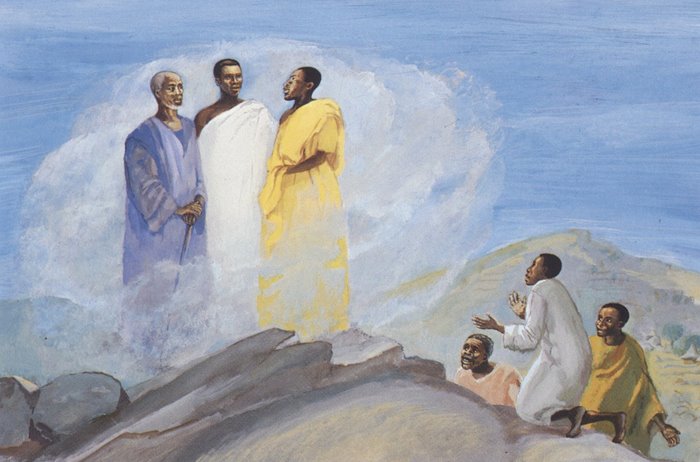
TRANSFIGURATION SUNDAY

Transfiguration of Jesus from Mafa
While doing graduate work in Communications for an art atelier at a university, an artist told me during an interview that there are two significant obsessions in the visual arts. The human figure and the landscape.
Thinking back generally about art expression over the millenia it appears this is a keen observation but also an insight with great import. Obsession with the self and one's environs is most likely expected as a given fundamental of human nature. But as with most obsessions, this can blind us to such other perspectives and opportunities that lend the possibility of seeing our selves and our environs as "transfigured." In the Mafa illustration above the appearance of Moses and Elijah with Jesus acts as a fulcrum in the gospel story, the lives of the disciples and as well the early development of what would come to be called Christianity. 

How does the Mafa rendition of this event speak to transfiguraton? What else is being transfigured besides the figure Jesus? What do you take from this transfiguration? Does it change how you see your landscape?


Mark 9:2-9
9:2 Six days later, Jesus took with him Peter and James and John, and led them up a high mountain apart, by themselves. And he was transfigured before them,

9:3 and his clothes became dazzling white, such as no one on earth could bleach them.

9:4 And there appeared to them Elijah with Moses, who were talking with Jesus.

9:5 Then Peter said to Jesus, "Rabbi, it is good for us to be here; let us make three dwellings, one for you, one for Moses, and one for Elijah."

9:6 He did not know what to say, for they were terrified.

9:7 Then a cloud overshadowed them, and from the cloud there came a voice, "This is my Son, the Beloved; listen to him!"

9:8 Suddenly when they looked around, they saw no one with them any more, but only Jesus.

9:9 As they were coming down the mountain, he ordered them to tell no one about what they had seen, until after the Son of Man had risen from the dead.

Friday, February 10, 2012

RESTORING COMMUNITY

Restoring Community
For close to twenty years I worked in hospitals. Assigned to areas of Neurosurgical Intermediate and Intensive Cares, Cardovascular and Neonatal Intensive Cares, as well as Emergency room and Ventilator Care. 
From this experience came the observation that once one is considered ill or infirm, the disease often assumes or becomes the identity of the person. They are no longer Larry or Jane or Bobby or Katelin. They are the lung cancer in 409. Their prognosis is their destiny. Their status is ostracization from the flow of routine society. 
A sort of out of sight out of mind relationship occurs between them and the rest of the "functioning community"
This was particularly true of Jesus' time in Judea. The sick, especially the leper was an outcast an outsider.
How did Jesus cross that line of ostracizing for the benefit of individuals in community?
Do we have "lepers" today that we ostracize. How might we follow Jesus' example to heal community one soul at a time?

Mark 1:40-45
1:40 A leper came to him begging him, and kneeling he said to him, "If you choose, you can make me clean."

1:41 Moved with pity, Jesus stretched out his hand and touched him, and said to him, "I do choose. Be made clean!"

1:42 Immediately the leprosy left him, and he was made clean.

1:43 After sternly warning him he sent him away at once,

1:44 saying to him, "See that you say nothing to anyone; but go, show yourself to the priest, and offer for your cleansing what Moses commanded, as a testimony to them."

1:45 But he went out and began to proclaim it freely, and to spread the word, so that Jesus could no longer go into a town openly, but stayed out in the country; and people came to him from every quarter.

Saturday, July 30, 2011

JESUS, HOMEBOYS, LOAVES, AND FISHES

 Jesus Is My Homeboy - Loaves and Fishes - David LaChapelle
Homeboy: noun; Originally used among transplanted African-Americans with Southern roots to refer to and aid in the assimilation of someone who might have directly migrated from a common Southern home town or is otherwise well known to the person using the term.
The epitome of a friend. Somebody you kick it with. A person who always has your back. You can't go through life without a homeboy. It's hard to have more than one, because they're one in a million. (The Urban Dictionary) 

 The photo above is from the artist and photographer, David LaChapelle. Highly influenced by Michelangelo, as well as present-day artists, LaChapelle desires to make commentary on our interdependence with modern consumer society. His Homeboy series also includes a New York street scene of a prostitute's arrest with Jesus' intervention. Jesus in a tenement kitchen with a modern-dressed,  Mary Magdalene wiping Jesus' feet with her long blonde hair, a Sermon on the streets, Jesus showing the wounds of his hands to everyday persons in a bedroom scene and a Leo Da Vinci-esque Lords Supper with myriad persons of hip-hop culture gathered are other works which LaChapelle said in a 2008 interview for The Art Newspaper TV. " If Jesus were here today, he said, he would be hanging out with the street people and the marginalized:  the poor, the homeless, prostitutes, drug dealers, gangsters, and so on.  And more than that, these people would have been his closest and most faithful band of followers."

In our lectionary lesson for this Sunday from the book of Matthew, verses 14:13-21, when the disciples say that the people of the crowd are hungry Jesus tells his disciples to feed them. What is their response?  In the light of a wealthy, consumer oriented society as exemplified in LaChapelle's rendition how does the miracle of the loaves and fishes speak to persons, Materially? Spiritually? How do we participate in the miracle today?

Matthew 14:13-21
14:13 Now when Jesus heard this, he withdrew from there in a boat to a deserted place by himself. But when the crowds heard it, they followed him on foot from the towns.

14:14 When he went ashore, he saw a great crowd; and he had compassion for them and cured their sick.

14:15 When it was evening, the disciples came to him and said, "This is a deserted place, and the hour is now late; send the crowds away so that they may go into the villages and buy food for themselves."

14:16 Jesus said to them, "They need not go away; you give them something to eat."

14:17 They replied, "We have nothing here but five loaves and two fish."

14:18 And he said, "Bring them here to me."

14:19 Then he ordered the crowds to sit down on the grass. Taking the five loaves and the two fish, he looked up to heaven, and blessed and broke the loaves, and gave them to the disciples, and the disciples gave them to the crowds.

14:20 And all ate and were filled; and they took up what was left over of the broken pieces, twelve baskets full.

14:21 And those who ate were about five thousand men, besides women and children.

Walter Morton for Journey Across the Line

Thursday, July 21, 2011

THE ROAD TO WISDOM


 Like art, wisdom is hard to pin down, but people generally recognize it when they encounter it. Psychologists pretty much agree it involves an integration of knowledge, experience, and deep understanding that incorporates tolerance for the uncertainties of life as well as its ups and downs. There's an awareness of how things play out over time, and it confers a sense of balance.
Wise people generally share an optimism that life's problems can be solved and experience a certain amount of calm in facing difficult decisions. Intelligence—if only anyone could figure out exactly what it is—may be necessary for wisdom, but it definitely isn't sufficient; an ability to see the big picture, a sense of proportion, and considerable introspection also contribute to its development. (Psychology Today: http://www.psychologytoday.com/basics/wisdom).

Praying for Wisdom:
I don't necessarily know why, but as a child I chose to pray for wisdom more than any other request from God. Of course when I became a teen, I was praying about every thing, just trying to figure out my way. The problem in asking for the intangibles of character is you can't see them until they are applied in context. So just as when we ask for patience, God uses our experiences to flesh out its presence in our lives, so too, wisdom appears as one of those character traits that become evident only when the situation calls for its expression.

Distance Learning:
I have received wisdom by observing others in situations and crises. This was particularly true being much younger than my brother and sister. I was able to see how they handled problems. And then I could reflect on whether in like circumstance I might approach such in the same manner or different. Vicarious learning is great and convenient, someone else stumbles and you get to participate in distance learning

The Wisdom of Experience:
But the greatest way to build wisdom for me has been through the personally lived experiences that God has provided for me in my daily experience. God has given me plenty of opportunities where I might gain wisdom from my mistakes. More than I believe I really needed perhaps. Probably one of the most fundamental characteristics of wisdom for me has been the "agnostic" approach. I am not using this term in the sense of not knowing whether there is a God or not. But agnostic in its generic sense which means "I am not informed regarding something or someone." So the process of learning about life is not so much a gathering of facts and making "wise" decisions, but the ability to sometimes say, "I don't know." That's my first step on the road to Wisdom.

What was Solomon's first step?
What is yours?   


 1 Kings 3:5-12
3:5 At Gibeon the LORD appeared to Solomon in a dream by night; and God said, "Ask what I should give you."

3:6 And Solomon said, "You have shown great and steadfast love to your servant my father David, because he walked before you in faithfulness, in righteousness, and in uprightness of heart toward you; and you have kept for him this great and steadfast love, and have given him a son to sit on his throne today.

3:7 And now, O LORD my God, you have made your servant king in place of my father David, although I am only a little child; I do not know how to go out or come in.

3:8 And your servant is in the midst of the people whom you have chosen, a great people, so numerous they cannot be numbered or counted.

3:9 Give your servant therefore an understanding mind to govern your people, able to discern between good and evil; for who can govern this your great people?"

3:10 It pleased the Lord that Solomon had asked this.

3:11 God said to him, "Because you have asked this, and have not asked for yourself long life or riches, or for the life of your enemies, but have asked for yourself understanding to discern what is right,

3:12 I now do according to your word. Indeed I give you a wise and discerning mind; no one like you has been before you and no one like you shall arise after you.

Walter MOrton for Journey Across the Line.

Friday, July 15, 2011

JACOB'S ZIGGURAT

Jacobs Ladder, Cameron Park, Waco, TX
Jacob's Ladder: When I was growing up in Waco, Texas, my friends and I often played in Cameron Park. This was an 1100 acre area of winding roads, trees, forest, riverbanks, and trails, with limestone cliffs rising hundreds of feet above the flowing Brazos River. It had been granted to the city of Waco years before by the Cameron family, a wealthy landowner from the early days in central Texas. It was truly an amazing place to adventure as a kid. One of the roads meandered up from the river through the wooded areas until it arrived at the top of the cliffs at a place called "lover's leap," where young lovers had once,  according to legend, plunged to the lime rock of the river below.

In one of the cliffs set back from the bank, steps had been laid, climbing steep and vertical from the riverbed skyward to the cliff top, each step was quite a stretch, especially for a kid. Stripped wood branches ascended along each side of the rough stairwell, known to all as "Jacob's Ladder." I cannot begin to recall how many times I traversed Jacob's but every time the story of Jacob's Ladder came up in Sunday school my mind was always reminded of that limestone ladder.

Escalara a la Luna / Georgia Okeeffe  1958
 Jacobs Dream: During the late 1950's in America there was a lot of dreaming about traveling into space or having aliens visit us, at least in films of the day. We eventually made it to the moon. But in 1958 it was still a dream, much like Georgia O'Keeffe'a rendering of "Escalara a la Luna." I appreciate the ladder which lingers above the earth but below the moon. Not quite connected to either. A vision of what may or can be in our lives, in our world.

Traditionally as I have thought about Jacob's dream I have thought about it in its metaphorical connection to reality. There are angels ascending and descending, those messengers of God and his will. We have always attempted to build some sort of bridge between the temporal and the eternal, in art, song, poem, and even as seen in the architecture of the ancient Mesopotamian plains.


US 82nd Airborne descends Ziggurat at Ur in modern Iraq
 
Home of the god: Ziggurats (Akkadian ziqqurat, "to build on a raised area") were massive structures built in the ancient Mesopotamian valley and western Iranian plateau, having the form of a terraced step pyramid of successively receding stories or levels. Built by the Sumerians, Babylonians, Elamites, Akkadians, and Assyrians  for local religions, each ziggurat was part of a temple complex which included other buildings.

The Mesopotamian ziggurats were not places for public worship or ceremonies. They were believed to be dwelling places for the gods and each city had its own patron god. Only priests were permitted on the ziggurat or in the rooms at its base, and it was their responsibility to care for the gods and attend to their needs. The priests were very powerful members of Sumerian society. The Mesopotamians believed that these pyramid temples connected heaven and earth. In fact, the ziggurat at Babylon was known as Etemenankia or "House of the Platform between Heaven and Earth". (Wikipedia)

In our lesson from the lectionary for today, we get a glimpse of heaven through the dream of Jacob at a place referred to as Luz. After his dream encounter, Jacob renames the place Bethel (place or house of God.) How does Jacob's encounter with the Holy change the relationship.between the patriarch and God in the context of his times? What does that mean for us today?

Genesis 28:10-19a
28:10 Jacob left Beer-sheba and went toward Haran.

28:11 He came to a certain place and stayed there for the night, because the sun had set. Taking one of the stones of the place, he put it under his head and lay down in that place.

28:12 And he dreamed that there was a ladder set up on the earth, the top of it reaching to heaven; and the angels of God were ascending and descending on it.

28:13 And the LORD stood beside him and said, "I am the LORD, the God of Abraham your father and the God of Isaac; the land on which you lie I will give to you and to your offspring;

28:14 and your offspring shall be like the dust of the earth, and you shall spread abroad to the west and to the east and to the north and to the south; and all the families of the earth shall be blessed in you and in your offspring.

28:15 Know that I am with you and will keep you wherever you go, and will bring you back to this land; for I will not leave you until I have done what I have promised you."

28:16 Then Jacob woke from his sleep and said, "Surely the LORD is in this place--and I did not know it!"

28:17 And he was afraid, and said, "How awesome is this place! This is none other than the house of God, and this is the gate of heaven."

28:18 So Jacob rose early in the morning, and he took the stone that he had put under his head and set it up for a pillar and poured oil on the top of it.

28:19a He called that place Bethel; but the name of the city was Luz at the first.

Walter Morton for Journey Across the Line


Thursday, July 7, 2011

SOWING THE WORLD ONE PERSON AT A TIME

Tree of Life
The early religious movement in Palestine that was the seed of the Christian faith, would face many trials. Not only from Roman and fellow Jewish antagonists, but also from internal struggles of the disciples themselves. There were times when the disciples fell away through their own fear and denial of what was to come. These two examples show how conflict and threat can come from both external and internal struggles.

Just as the early Christian faith struggled, we too. as individuals, struggle in our lives. The parable of the sower in today's lesson from Matthew 13:1-9, 18-23, illustrates Jesus' awareness of what living life is truly like."Listen, a sower went out to sow..." the story begins. Just as simply as that, like our own lives, we set about a task of living through simple deeds, we think. But it's the struggles that make them complicated. We come to find that the simple "nouns" of our lives need the addition of "adjectives" coming alongside to bolster our deeds. We are emotional creations and desire the use of adjectives to give our daily deeds Spiritual meaning.

Jesus speaks of soil, water, sun, thistles, roots, birds and other things that the seed needs or struggles against. Speaking for our own lives and its development, what do we need simply to grow and how do we handle the conflicts that are an inevitable part of the complexity of living the faith?  

Matthew 13:1-9, 18-23
13:1 That same day Jesus went out of the house and sat beside the sea.

13:2 Such great crowds gathered around him that he got into a boat and sat there, while the whole crowd stood on the beach.

13:3 And he told them many things in parables, saying: "Listen! A sower went out to sow.

13:4 And as he sowed, some seeds fell on the path, and the birds came and ate them up.

13:5 Other seeds fell on rocky ground, where they did not have much soil, and they sprang up quickly, since they had no depth of soil.

13:6 But when the sun rose, they were scorched; and since they had no root, they withered away.

13:7 Other seeds fell among thorns, and the thorns grew up and choked them.

13:8 Other seeds fell on good soil and brought forth grain, some a hundredfold, some sixty, some thirty.

13:9 Let anyone with ears listen!"

13:18 "Hear then the parable of the sower.

13:19 When anyone hears the word of the kingdom and does not understand it, the evil one comes and snatches away what is sown in the heart; this is what was sown on the path.

13:20 As for what was sown on rocky ground, this is the one who hears the word and immediately receives it with joy;

13:21 yet such a person has no root, but endures only for a while, and when trouble or persecution arises on account of the word, that person immediately falls away.

13:22 As for what was sown among thorns, this is the one who hears the word, but the cares of the world and the lure of wealth choke the word, and it yields nothing.

13:23 But as for what was sown on good soil, this is the one who hears the word and understands it, who indeed bears fruit and yields, in one case a hundredfold, in another sixty, and in another thirty."

Walter Morton for Journey Across the Line 

Thursday, June 23, 2011

FAITH OR CULT?

"Ram in Thicket" (Royal Death Pit, Ur of Chaldees) British Museum
This week we look at one of the most complex and loaded texts of the Jewish scriptures: The binding of Isaac in Genesis 22:1-14. Many interpretations have been postured by our Jewish, Christian, Muslim and Biblical critical traditions. Is it a test for Isaac, Abraham, or God himself?

I believe it may be the test of a new faith in its early stages of development and that just might have implications for our journey of faith today. How do we commit to leave behind what has become an impediment to our lives and our communities' future?

We'll begin looking at some oral tradition regarding Abraham's background and an integral symbol in the narrative text, the Ram caught in the thicket.

Biblical Archaeolgy:
The Ram in a Thicket is one of a pair of figures excavated in Ur, in southern Iraq, and which date from about 2600-2400 BC. One is currently exhibited in the British Museum in London.  the other is in the University of Pennsylvania Museum in Philadelphia, Pennsylvania. .

The pair of rams were discovered lying close together in the 'Great Death Pit', one of the graves in the Royal Cemetery at Ur, by archaeologist Leonard Woolley during the 1928-9 season. He named the figure the 'Ram in a Thicket' after the passage in Genesis 22 v.13, where God orders the Biblical Patriarch Abraham  to sacrifice his son Isaac.(from Wikipedia, Ram in the Thicket)

Biblical Literary Criticism:
 In Mimesis: The Representation of Reality in Western Literature, the literary critic Erich Auerbach considers the Hebrew narrative of the Binding of Isaac, along with Homer's description of Odysseus's scar, as the two paradigmatic models for the representation of reality in literature. Auerbach contrasts Homer's attention to detail and foregrounding of the spatial, historical, as well as personal contexts for events to the Bible's sparse account, in which virtually all context is kept in the background or left outside of the narrative. As Auerbach observes, this narrative strategy virtually compels readers to add their own interpretations to the text. (from Wikipedia, Binding of Isaac)

Genesis 22:1-14
22:1 After these things God tested Abraham. He said to him, "Abraham!" And he said, "Here I am."

22:2 He said, "Take your son, your only son Isaac, whom you love, and go to the land of Moriah, and offer him there as a burnt offering on one of the mountains that I shall show you."

22:3 So Abraham rose early in the morning, saddled his donkey, and took two of his young men with him, and his son Isaac; he cut the wood for the burnt offering, and set out and went to the place in the distance that God had shown him.

22:4 On the third day Abraham looked up and saw the place far away.

22:5 Then Abraham said to his young men, "Stay here with the donkey; the boy and I will go over there; we will worship, and then we will come back to you."

22:6 Abraham took the wood of the burnt offering and laid it on his son Isaac, and he himself carried the fire and the knife. So the two of them walked on together.

22:7 Isaac said to his father Abraham, "Father!" And he said, "Here I am, my son." He said, "The fire and the wood are here, but where is the lamb for a burnt offering?"

22:8 Abraham said, "God himself will provide the lamb for a burnt offering, my son." So the two of them walked on together.

22:9 When they came to the place that God had shown him, Abraham built an altar there and laid the wood in order. He bound his son Isaac, and laid him on the altar, on top of the wood.

22:10 Then Abraham reached out his hand and took the knife to kill his son.

22:11 But the angel of the LORD called to him from heaven, and said, "Abraham, Abraham!" And he said, "Here I am."

22:12 He said, "Do not lay your hand on the boy or do anything to him; for now I know that you fear God, since you have not withheld your son, your only son, from me."

22:13 And Abraham looked up and saw a ram, caught in a thicket by its horns. Abraham went and took the ram and offered it up as a burnt offering instead of his son.

22:14 So Abraham called that place "The LORD will provide"; as it is said to this day, "On the mount of the LORD it shall be provided."

Thursday, June 16, 2011

CREATION AND RECREATION

From Summer 2009
It's that time again. Time for re-creation in our lives. It's our celebration of the Sabbath, Father's Day, Trinity Sunday and, as well, Summer officially starts this week. Two Summers ago the Journey class spent time on the pond at the Dortch's (as the pictures attest)  and we're doing it again this Sunday 19 June, Lord permitting.

For our study, we will be looking at Psalm 8, that glorious passage that refers to God's majesty, creation, and our place and responsibility as part in it. What does it mean that God is mindful of us? And what does that say about our mindfulness of others? What role does the act of recreation play in these issues? 

Psalm 8
8:1 O LORD, our Sovereign, how majestic is your name in all the earth! You have set your glory above the heavens.

8:2 Out of the mouths of babes and infants you have founded a bulwark because of your foes, to silence the enemy and the avenger.

8:3 When I look at your heavens, the work of your fingers, the moon and the stars that you have established;

8:4 what are human beings that you are mindful of them, mortals that you care for them?

8:5 Yet you have made them a little lower than God, and crowned them with glory and honor.

8:6 You have given them dominion over the works of your hands; you have put all things under their feet,

8:7 all sheep and oxen, and also the beasts of the field,

8:8 the birds of the air, and the fish of the sea, whatever passes along the paths of the seas.

8:9 O LORD, our Sovereign, how majestic is your name in all the earth!

Walter Morton for Journey Across the Line

Tuesday, June 7, 2011

THE DNA OF OUR LIVES

An artist's rendition of a DNA strand
Just as our DNA has four elements, Guanine, Cytosine, Adenine and Thyamine, that determine being biologically human, our story for Pentecost today covers four elements, A little research on Prophecy, Pentecost, Shavuot and Grain Harvests from Wikipedia:

Prophecy is a process in which one or more messages that have been communicated to a true prophet are then communicated to others by this true prophet. Such messages typically involve divine inspiration, interpretation, or revelation of conditioned events to come as well as testimonies or repeated revelations that the world is divine. The process of prophecy especially involves reciprocal communication of the true prophet with the (divine) source of the messages. Mere claimants of foreknowledge of future events, like fortunetellers, oracles, seers, diviners or apocalyptic authors, are not considered true prophets


Pentecost (Ancient Greek) Πεντηκοστή [ἡμέρα], Pentēkostē [hēmera], "the Fiftieth [day]") is one of the prominent feasts in the Christian Liturgical Year commemorating the descent of the Holy Spirit upon the disciples of Christ after the Resurrection as described in the New Testament Acts of the Apostles :2:1-31. For this reason, Pentecost is sometimes described as the "Birthday of the Church". Pentecost is celebrated seven weeks (50 days) after Easter Sunday, hence its name. Pentecost falls ten days after Ascension Thursday. Pentecost is historically and symbolically related to the Jewish harvest festival of  Shavuot which commemorates God giving the Ten Commandments at Mount Sinai fifty days after the Exodus.

Shavuot is a Jewish holiday that occurs on the sixth day of the Hebrew month of Sivan (late May or early June). Shavuot commemorates the anniversary of the day God gave the Torah to the entire Israelite nation assembled at Mount Sinai, although the association between the giving of the Torah (Matan Torah) and Shavuot is not explicit in the Biblical text. The holiday is one of the Shalosh Regalim, the three Biblical pilgrimage festivals. It marks the conclusion of the Counting of the Omer. The Torah mandates the seven-week Counting of the Omer, beginning on the second day of Passover and immediately followed by Shavuot. This counting of days and weeks is understood to express anticipation and desire for the Giving of the Torah. On Passover, the Jewish people were freed from their enslavement to Pharaoh, on Shavuot they were given the Torah and became a nation committed to serving God.  Since Shavuot occurs 50 days after Passover, Hellenistic Jews gave it the name Pentecost (πεντηκοστή, "fiftieth day").


Harvests: Besides its significance as the day on which the Torah was revealed by God to the Jewish nation at Mount Sinai (which includes the Ten Commandments), Shavuot is also connected to the season of the grain harvest in Israel. In ancient times, the grain harvest lasted seven weeks and was a season of gladness (Jer. 5:24, Deut. 16:9-11, Isa. 9:2). It began with the harvesting of the barley during Passover and ended with the harvesting of the wheat at Shavuot. Shavuot was thus the concluding festival of the grain harvest, just as the eighth day of Sukkot (Tabernacles) was the concluding festival of the fruit harvest. During the existence of the Temple in Jerusalem an offering of two loaves of bread from the wheat harvest was made on Shavuot.

Just as our DNA holds elements that are prophetic in the outcome of our being human, a lot of elements went into the building of Pentecost, all of them, in some sense, prophetic. In the stories presented in Numbers and in Acts, how does God speak to us through bread, law, spirit and prophecy? How do we fulfill the prophecy of our lives and maintain the presence of His abiding Spirit amongst us?.

Numbers 11:24-30
11:24 So Moses went out and told the people the words of the LORD; and he gathered seventy elders of the people, and placed them all around the tent.

11:25 Then the LORD came down in the cloud and spoke to him, and took some of the spirit that was on him and put it on the seventy elders; and when the spirit rested upon them, they prophesied. But they did not do so again.

11:26 Two men remained in the camp, one named Eldad, and the other named Medad, and the spirit rested on them; they were among those registered, but they had not gone out to the tent, and so they prophesied in the camp.

11:27 And a young man ran and told Moses, "Eldad and Medad are prophesying in the camp."

11:28 And Joshua son of Nun, the assistant of Moses, one of his chosen men, said, "My lord Moses, stop them!"

11:29 But Moses said to him, "Are you jealous for my sake? Would that all the Lord's people were prophets, and that the LORD would put his spirit on them!"

11:30 And Moses and the elders of Israel returned to the camp


Acts 2:1-21
2:1 When the day of Pentecost had come, they were all together in one place.

2:2 And suddenly from heaven there came a sound like the rush of a violent wind, and it filled the entire house where they were sitting.

2:3 Divided tongues, as of fire, appeared among them, and a tongue rested on each of them.

2:4 All of them were filled with the Holy Spirit and began to speak in other languages, as the Spirit gave them ability.

2:5 Now there were devout Jews from every nation under heaven living in Jerusalem.

2:6 And at this sound the crowd gathered and was bewildered, because each one heard them speaking in the native language of each.

2:7 Amazed and astonished, they asked, "Are not all these who are speaking Galileans?

2:8 And how is it that we hear, each of us, in our own native language?

2:9 Parthians, Medes, Elamites, and residents of Mesopotamia, Judea and Cappadocia, Pontus and Asia,

2:10 Phrygia and Pamphylia, Egypt and the parts of Libya belonging to Cyrene, and visitors from Rome, both Jews and proselytes,

2:11 Cretans and Arabs--in our own languages we hear them speaking about God's deeds of power."

2:12 All were amazed and perplexed, saying to one another, "What does this mean?"

2:13 But others sneered and said, "They are filled with new wine."

2:14 But Peter, standing with the eleven, raised his voice and addressed them, "Men of Judea and all who live in Jerusalem, let this be known to you, and listen to what I say.

2:15 Indeed, these are not drunk, as you suppose, for it is only nine o'clock in the morning.

2:16 No, this is what was spoken through the prophet Joel:

2:17 'In the last days it will be, God declares, that I will pour out my Spirit upon all flesh, and your sons and your daughters shall prophesy, and your young men shall see visions, and your old men shall dream dreams.

2:18 Even upon my slaves, both men and women, in those days I will pour out my Spirit; and they shall prophesy.

2:19 And I will show portents in the heaven above and signs on the earth below, blood, and fire, and smoky mist.

2:20 The sun shall be turned to darkness and the moon to blood, before the coming of the Lord's great and glorious day.

2:21 Then everyone who calls on the name of the Lord shall be saved.'


Walter Morton  for Journey Across the Line

Thursday, June 2, 2011

THE LAST FOOTPRINT

Dome of the Ascension in Jerusalem
On the Mount of Olives, Muslims, who recognize much of the Old Testament as holy scripture and venerate Jesus as a prophet, control a mosque marking the spot of his ascension; there’s even a footprint in stone said to be Jesus’ last. Nearby, Carmelite nuns operate a beautiful church dedicated to the teaching of the Lord’s Prayer, even though Jesus almost certainly taught this simple means of communicating with God up in Galilee.
 
Many of the faithful have yielded to the understandable human desire to apply Bible stories, events, and personalities at a next level, attempting to link their faith to a specific physical spot that can be experienced with the senses. This drive to connect to a place, to deepen faith by finding and venerating a specific piece of the planet where supernatural Biblical events occurred has produced some perplexing results. (Walking in the Footsteps of Jesus, wwwTravelpod.com)
 
How do we testify to the footprint or steps of Jesus in our lives today?

Acts 1:6-14
1:6 So when they had come together, they asked him, "Lord, is this the time when you will restore the kingdom to Israel?"

1:7 He replied, "It is not for you to know the times or periods that the Father has set by his own authority.

1:8 But you will receive power when the Holy Spirit has come upon you; and you will be my witnesses in Jerusalem, in all Judea and Samaria, and to the ends of the earth."

1:9 When he had said this, as they were watching, he was lifted up, and a cloud took him out of their sight.

1:10 While he was going and they were gazing up toward heaven, suddenly two men in white robes stood by them.

1:11 They said, "Men of Galilee, why do you stand looking up toward heaven? This Jesus, who has been taken up from you into heaven, will come in the same way as you saw him go into heaven."

1:12 Then they returned to Jerusalem from the mount called Olivet, which is near Jerusalem, a sabbath day's journey away.

1:13 When they had entered the city, they went to the room upstairs where they were staying, Peter, and John, and James, and Andrew, Philip and Thomas, Bartholomew and Matthew, James son of Alphaeus, and Simon the Zealot, and Judas son of James.

1:14 All these were constantly devoting themselves to prayer, together with certain women, including Mary the mother of Jesus, as well as his brothers.

Walter Morton for Journey Across the Line

Saturday, May 28, 2011

Keep my Mitzvahs...

Mitzvah is the Jewish word for laws or commandments, particularly from God. A mitzvah is a command by which we are to direct our lives. Of course, as creatures endowed with God's spirit we also possess free will.

Laws were historically preceded by proverbs or wise sayings in the lands of Mesopotamia, Sumeria and Egypt. Proverbs are considered wisdom literature. They speak of ways of "right living" that reflect the mores of a society.  What we would call today, "the conventional wisdom." Of course life can demonstrate to us that following the proverbs does not necessarily guarantee a flawless experience. 


Cuineform, an early proto-form of writing developed in Sumeria was some of the first inscription to record actual laws on stone. Being more specific than a proverb, early lists or codices of laws were developed to meet individual circumstances: killing. stealing, abuse, denigrating a god's property. One of the most famous is the Code of Hammurabi: an attempt to set up a judicial system regarding conduct and resultant punishment if the code is not followed.

For the Ten Commandments , we often remember their opening phrase "Thou shalt not" more than the "Remember,"  and "Honor" phrases spoken of in two of the commandments. 


In Jesus' commandment to keep his commandments, how do "remember" and "honor' play a part in carrying out these elements in our daily lives. What are the commandments he wants us to keep? 
What happens if we don't keep them? How is this conventional wisdom for our time?

John 14:15-21
14:15 "If you love me, you will keep my commandments.

14:16 And I will ask the Father, and he will give you another Advocate, to be with you forever.

14:17 This is the Spirit of truth, whom the world cannot receive, because it neither sees him nor knows him. You know him, because he abides with you, and he will be in you.

14:18 "I will not leave you orphaned; I am coming to you.

14:19 In a little while the world will no longer see me, but you will see me; because I live, you also will live.

14:20 On that day you will know that I am in my Father, and you in me, and I in you.

14:21 They who have my commandments and keep them are those who love me; and those who love me will be loved by my Father, and I will love them and reveal myself to them."

Walter Morton for Journey Across the Line

Thursday, May 19, 2011

DEATH BY STONING

A Somali man prays not to be stoned to death
Reportedly, Billy Graham once said, "There is nothing as bad as bad religion."

For today's lectionary choice, we are looking at the stoning of Stephen. Considered the first biblical martyr of Christianity, it was the same form of punishment used against the woman caught in adultery that Jesus rescued from punishment. The image shown is preparation for the stoning of a Somali man caught in adultery.

What are the important aspects of Stephen's story to you? What does Stephens ordeal say about his faith when Christianity was still in its early days as a "movement?"

On the other side of the issue: How do we compare this with two millennia of Christian tradition? How do we create a world that no longer desires to stone, burn or destroy that which is human? 


Acts 7:55-60
7:55 But filled with the Holy Spirit, he gazed into heaven and saw the glory of God and Jesus standing at the right hand of God.

7:56 "Look," he said, "I see the heavens opened and the Son of Man standing at the right hand of God!"

7:57 But they covered their ears, and with a loud shout all rushed together against him.

7:58 Then they dragged him out of the city and began to stone him; and the witnesses laid their coats at the feet of a young man named Saul.

7:59 While they were stoning Stephen, he prayed, "Lord Jesus, receive my spirit."

7:60 Then he knelt down and cried out in a loud voice, "Lord, do not hold this sin against them." When he had said this, he died.

Walter Morton for Journey Across the Line

Saturday, May 14, 2011

PSALM 23

Today from the lectionary, we will be looking at Psalm 23. Traditionally thought to be written by David, the Psalms are hymns, or what might be called music for the soul of man. The ability to calm and soothe the anxieties of our existence is no small task. One of the phrases the Psalm recounts is "he leads me beside still waters." On a planet two-thirds covered in water that's an important thing to know.

 In our class we will take a look at the 23rd Psalm as it comes from the Hebrew and the meanings that has for our lives. So read though the Psalm and see what is meaningful to you.

 Psalm 23
23:1 The LORD is my shepherd, I shall not want.

23:2 He makes me lie down in green pastures; he leads me beside still waters;

23:3 he restores my soul. He leads me in right paths for his name's sake.

23:4 Even though I walk through the darkest valley, I fear no evil; for you are with me; your rod and your staff-- they comfort me.

23:5 You prepare a table before me in the presence of my enemies; you anoint my head with oil; my cup overflows.

23:6 Surely goodness and mercy shall follow me all the days of my life, and I shall dwell in the house of the LORD my whole life long.

Walter Morton for Journey Across the Line

Thursday, May 5, 2011

THE EMMAUS ROAD SHOW

The Emmaus Road Show

Today, we look at the narrative of  when Jesus shows himself to two on the road to Emmaus. It comes after his resurrection. He appears unrecognized at first and then becomes recognized as they journey forward. 

It appears that many times we do not recognize the value of persons, events or things in our lives until we have spent time with them. There is a popular weekly television program that goes by the name of The Antiques Road Show where persons bring in their items and heirlooms and are often surprised to find the value to be worth more than they ever thought. And with each item there is always, always a story that goes with it.

The image shown  here is a road of antiquity, thought to be part of the road to Emmaus. It is narrow, overgrown and in need of repair.

In the lesson today, from the gospel of Luke, we have the appearance of Jesus to two who are making a journey. How did Jesus show them that they were worth more than they ever thought? How does he widen their experience, give them growth and repair their road?

Luke 24:13-35
24:13 Now on that same day two of them were going to a village called Emmaus, about seven miles from Jerusalem,

24:14 and talking with each other about all these things that had happened.

24:15 While they were talking and discussing, Jesus himself came near and went with them,

24:16 but their eyes were kept from recognizing him.

24:17 And he said to them, "What are you discussing with each other while you walk along?" They stood still, looking sad.

24:18 Then one of them, whose name was Cleopas, answered him, "Are you the only stranger in Jerusalem who does not know the things that have taken place there in these days?"

24:19 He asked them, "What things?" They replied, "The things about Jesus of Nazareth, who was a prophet mighty in deed and word before God and all the people,

24:20 and how our chief priests and leaders handed him over to be condemned to death and crucified him.

24:21 But we had hoped that he was the one to redeem Israel. Yes, and besides all this, it is now the third day since these things took place.

24:22 Moreover, some women of our group astounded us. They were at the tomb early this morning,

24:23 and when they did not find his body there, they came back and told us that they had indeed seen a vision of angels who said that he was alive.

24:24 Some of those who were with us went to the tomb and found it just as the women had said; but they did not see him."

24:25 Then he said to them, "Oh, how foolish you are, and how slow of heart to believe all that the prophets have declared!

24:26 Was it not necessary that the Messiah should suffer these things and then enter into his glory?"

24:27 Then beginning with Moses and all the prophets, he interpreted to them the things about himself in all the scriptures.

24:28 As they came near the village to which they were going, he walked ahead as if he were going on.

24:29 But they urged him strongly, saying, "Stay with us, because it is almost evening and the day is now nearly over." So he went in to stay with them.

24:30 When he was at the table with them, he took bread, blessed and broke it, and gave it to them.

24:31 Then their eyes were opened, and they recognized him; and he vanished from their sight.

24:32 They said to each other, "Were not our hearts burning within us while he was talking to us on the road, while he was opening the scriptures to us?"

24:33 That same hour they got up and returned to Jerusalem; and they found the eleven and their companions gathered together.

24:34 They were saying, "The Lord has risen indeed, and he has appeared to Simon!"

24:35 Then they told what had happened on the road, and how he had been made known to them in the breaking of the bread.

Walter Morton for Journey Across the Line

Thursday, April 28, 2011

SEEING IS BELIEVING?

In our lesson from the lectionary for this May 1st, the first Sunday after Easter, we look at the appearance of Jesus to his followers. But it seems Thomas didn't get the email, so he wasn't there. Jesus appears again and this time he shows his hands so Thomas might believe.

Could the message on the hand in the image have been something that Jesus was attempting to also communicate to Thomas?


What does it mean to believe? Is it different than faith? If so, what are the differences?


Have you ever had a time in your life when it didn't seem to matter what you believed but rather if you had faith?


John 20:19-31
20:19 When it was evening on that day, the first day of the week, and the doors of the house where the disciples had met were locked for fear of the Jews, Jesus came and stood among them and said, "Peace be with you."

20:20 After he said this, he showed them his hands and his side. Then the disciples rejoiced when they saw the Lord.

20:21 Jesus said to them again, "Peace be with you. As the Father has sent me, so I send you."

20:22 When he had said this, he breathed on them and said to them, "Receive the Holy Spirit.

20:23 If you forgive the sins of any, they are forgiven them; if you retain the sins of any, they are retained."

20:24 But Thomas (who was called the Twin), one of the twelve, was not with them when Jesus came.

20:25 So the other disciples told him, "We have seen the Lord." But he said to them, "Unless I see the mark of the nails in his hands, and put my finger in the mark of the nails and my hand in his side, I will not believe."

20:26 A week later his disciples were again in the house, and Thomas was with them. Although the doors were shut, Jesus came and stood among them and said, "Peace be with you."

20:27 Then he said to Thomas, "Put your finger here and see my hands. Reach out your hand and put it in my side. Do not doubt but believe."

20:28 Thomas answered him, "My Lord and my God!"

20:29 Jesus said to him, "Have you believed because you have seen me? Blessed are those who have not seen and yet have come to believe."

20:30 Now Jesus did many other signs in the presence of his disciples, which are not written in this book.

20:31 But these are written so that you may come to believe that Jesus is the Messiah, the Son of God, and that through believing you may have life in his name.

Walter Morton for Journey Across the Line